Last week, the seeds did their work.
This week, something answered.
This week’s prompt:
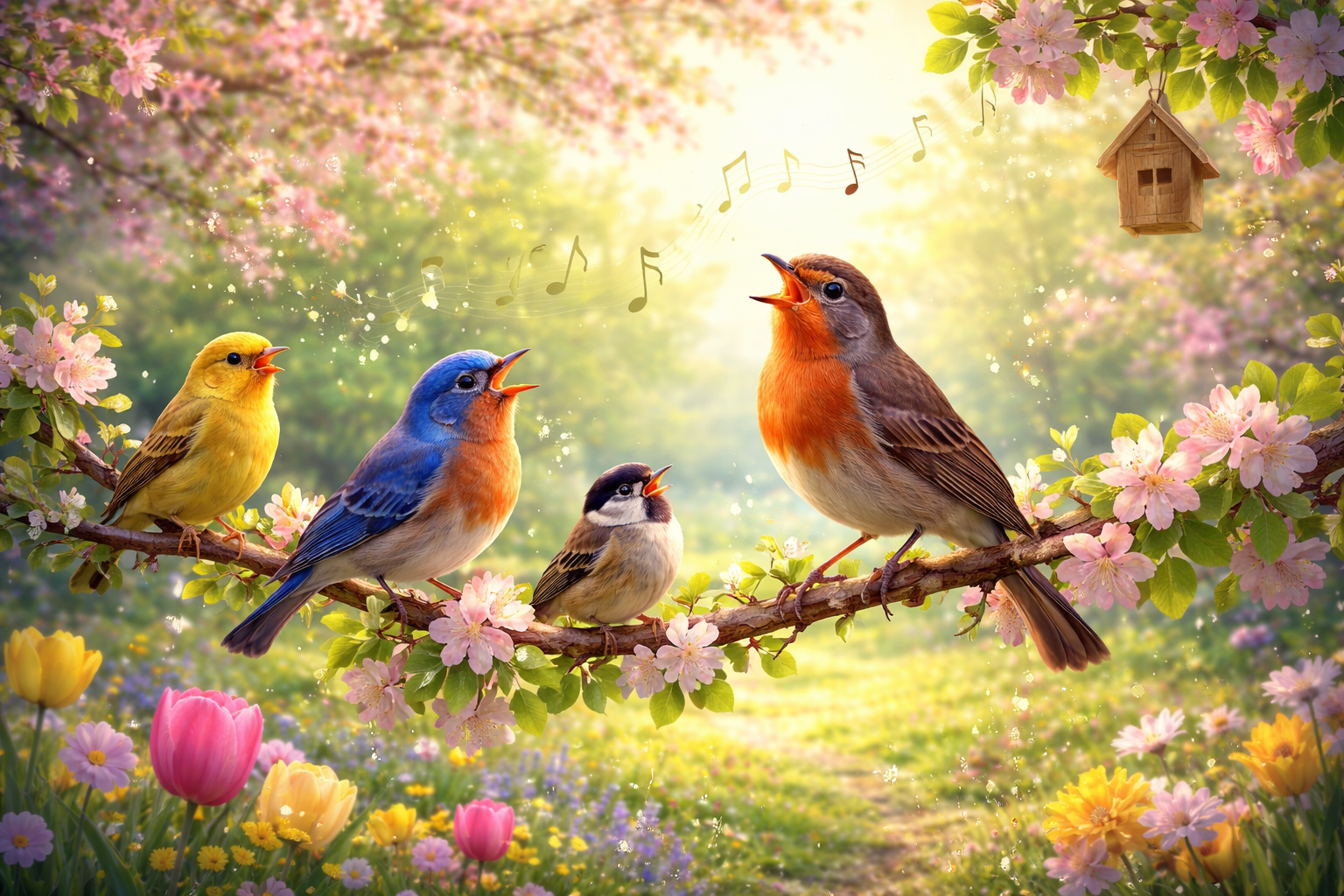
› It’s spring. The birds are singing . . . in English.
It sounds simple—until you start to understand what they’re saying. Every chirp carries meaning. Every call feels intentional. Some hear warnings. Some hear arguments. Some wish they’d never listened at all.
There was no word count this time. No boundaries. Just a simple invitation: listen, and write what you hear.
What came back was a chorus of very different voices. Some unsettling. Some thoughtful. A few that hit a little too close to home.
Dig in and see what they had to say . . .
A big thanks to everyone who participated and kept the challenge alive this week!
- John Cox
- Neviena Dēls
- Kathy Goddard writer
- J.W. Jones Author
- Eolas Pellor
- Jesse R Traynham - Author
- Mary Zuelke Author
Table of Contents
- The Birds Speak to Billy by John Cox
- A Season of Clear Voices by Neviena Dēls
- Dawn Chorus by Kathy Goddard writer
- The Threshold Blooms by J.W. Jones Author
- The Accusers by Eolas Pellor
- Section 4.2: Nesting Compliance by Jesse R Traynham - Author
- Springtime Happiness by Mary Zuelke Author
Likes: 4
Words: 285
I guess it was inevitable - me and reality have definitely finally company. Can’t even blame a hangover. Haven’t touched a drop for weeks despite the plentiful supply. No point.
So how do you explain the fact that those damn birds are doing their usual dawn chorus gig, singing and squawking away, but instead of whistles and chirrups they’re performing operas - in English. I can understand every single word. Wish I couldn’t.
Burying my head under the pillow makes very little difference to the volume. Blimey, they’ve got a lot to get off their chests.
‘Back off buddy, this is my territory and I’ll fight to the death to protect it. Don’t believe me? Dare you to try.’
‘Think I’m scared of you? I’m the biggest and the best. I’m the one that’ll attract any females, not you.’
Can’t believe I can hear each separate challenge considering they’re all shrieking at the same time. Hang on, there’s a new voice.
‘Stop squabbling boys. Don’t fight over me - I’ve already made my choice. There aren’t enough of us left to risk another death. There are plenty of overgrown gardens now that there’s no one to tend them - you go and look elsewhere.’ Sore point. I try burrowing deeper under the quilt but those damned birds just won’t be silenced.
‘Me? Why should I give up the chance to mate?’’
‘You know I have to procreate with biggest and strongest. Right now that’s him. Go and find your own territory.’
‘At least you have a chance of finding a mate, unlike that poor bugger in the brick nest.’
‘That’s true. Doesn’t bear thinking about, does it. Can’t imagine how he must feel being the last of his species.’
by Eolas Pellor
Likes: 4
Words: 415
I walked away from the burning huts as dawn was beginning to break. The birds kept twittering away, little feathery lechers and braggarts. I’d gone some way when I realised I could still understand them, even though the wish for them to speak had been undone a long time ago.
I suppose when I was in the mines and caves there were no birds to hear, and since I’d left I’d had my mind on other things, but now, in the aftermath of the killings, I felt clear-minded and clean, and i could understand every damned tweet and warble. Of course, a lot of it was the same stuff I’d heard the last time, but now there was something more to it.
“It’s Grom, come red handed from killing three whole households,” a finch sang.
“Grama, they should call him,” a blackbird replied. “Once a slave, and still mastered by anger.”
“Damn you all,” I replied. “What do you know about it?”
“You slew them all…all…all…all,” a great tit screamed in my ear. “There’s blood on your claw…claw…claw…claws!”
“They deserved it. They killed my Sarach,” I said, hotly. “I couldn’t let them go unpunished.”
“Such a shame…shame…shame…shame…shame,” the tit agreed.
Another tit came flying from the edges of the river to enjoy the bounty. He poked around for some time before he noticed me sitting there, with my back against an old elder.
“Who’s that…that…that…that?” he asked the others.
“Gorm,” a finch replied. ”Fresh from his revenge.” I nodded. The newcomer landed on my outstretched claw and looked at me, with his head turned to one side.
“You should not wait…wait…wait…wait!” he said. “You should hurry…hurry…hurry…hurry!” he turned his head slightly, keeping one little bead of an eye on me.
“Why should I hurry, my enemies are dead,” I replied.
“Not so…so…so…so!” the tit replied. “Strangers…strangers…stranger…strangers…. Come to take your treasure…treasure…treasure….treasure.”
“What more could anyone steal from me?” I asked bitterly. “The humans took my love away. They threw her from the high place.” “You’ll see…see…see…see!” he insisted. I stirred uneasily, looking back toward the river. I stood up and the birds scattered in front of me, not that I meant them any ill. It was probably nothing at all, but I hurried homeward – as if I could call it home, any longer.
by Neviena Dēls
Likes: 3
Words: 410
The first one to notice was Daniel Pike, who lived alone and spoke to no one unless it was necessary.
He paused halfway through buttering his toast, the knife hovering in midair, as the magpie outside his kitchen window cleared its throat and said, quite distinctly, “Bit early to be worrying about cholesterol, isn’t it?” Daniel didn’t answer. He finished buttering the toast. He ate it. Only then did he look up.
The magpie tilted its head, one bright eye fixed on him. “Rude,” it said.
By mid-morning, the neighbourhood had begun to hum with it. Sparrows argued over property lines in clipped, efficient bursts. A pair of lorikeets hurled obscenities with inventive enthusiasm. Somewhere down the street, a pigeon apologized over and over, though no one seemed quite sure what for.
Daniel walked to the park to confirm it wasn’t just him.
It wasn’t.
A small crowd had gathered beneath the jacaranda, listening as a cluster of cockatoos debated municipal zoning laws with unsettling precision.
“They’re not wrong,” someone muttered.
“They’re birds,” another replied, as if that should settle it.
A child stepped forward and asked one of them what it was like to fly.
The cockatoo considered the question for a moment. “Efficient,” it said at last. “You people have made it unnecessarily complicated.”
By the afternoon, the news had caught up. Experts speculated. Officials urged calm. The birds, for the most part, ignored them.
Daniel returned home just before dusk. The magpie was still there.
“You’re taking this well,” it said.
“I don’t see the point in panicking,” Daniel replied.
“Good,” said the magpie. It shifted slightly on the sill. “We’ve been meaning to talk to you.”
Daniel hesitated. “About what?”
The magpie glanced toward the darkening sky, where silhouettes circled in widening arcs.
“Your kind,” it said, “has been very loud for a very long time.”
“And now?” Daniel asked.
“Now,” said the magpie, “we thought we’d try being understood.” For a while, neither of them spoke. The evening filled in around them: birdsong layered with something new, something quieter; fragments of thought, half-formed sentences, laughter that didn’t quite belong in beaks.
Daniel leaned against the counter. “And after that?”
The magpie watched him carefully, as if measuring something he couldn’t see. “Well,” it said at last, “that depends entirely on how the conversation goes.”
Likes: 3
Words: 2048
The envelope arrived on a Tuesday in late March 2026, unmarked except for that stark red command stamped across the front in bold, dripping letters: Plant Immediately. No return address. No label. Just a thin foil packet inside, heavy for its size, as if the contents carried more than mere potential.
I live on the east side of Louisville, Kentucky, in a modest A frame house with a backyard that backs up to a tangle of woods and an old creek bed. The kind of place where nothing much happens except the occasional raccoon raid on the trash. I’d read the news warnings, Texas had collected over a thousand of these mystery packets since early 2025, many traced vaguely to China, part of some brushing scam or worse. Agriculture officials in multiple states screamed the same refrain: do not open, do not plant, report immediately. Biosecurity nightmare waiting to bloom.
But that night, after a long shift at the warehouse, something in me snapped. Maybe it was the quiet hum of the fridge, the way the dog stared at the packet like it whispered secrets, or the simple, stupid ache for wonder in a world that felt increasingly scripted. I told myself they were safe. I assumed they were safe. I tore the foil in the kitchen under the harsh overhead light.
Out spilled six tiny seeds, each a perfect obsidian teardrop no bigger than a grain of rice, flecked with microscopic points of iridescent light that shifted when I turned them in my palm. They felt warm. Alive. Not like any seed I’d ever held from the garden center.
I planted them that same hour, just after midnight, in the far back corner of the yard behind the shed, away from the vegetable beds and the rose bushes my late wife had loved. Six shallow holes in the damp clay soil, a sprinkle of compost, a gentle watering from the hose. I patted the earth and whispered, half-joking, “Grow something beautiful.”
By dawn, they had already broken ground.
Not fragile green shoots. Six translucent pillars, the color of moonlit water, rose nearly a foot overnight. They swayed in perfect unison though there was no breeze. Hollow inside, I could see faint violet veins pulsing slowly, like sluggish blood. By noon they stood knee-high, and the air around them carried a faint scent of ozone mixed with something sweet and alien, honey over warm stone, or the distant memory of rain on a planet without a name.
I didn’t call anyone. Who would believe me? The neighbors’ kids played soccer two yards over; the mailman waved as usual. The stalks stayed hidden behind the fence and the shed. But I felt them. A low vibration in the ground when I walked barefoot on the grass.
On the third day they reached my waist. The violet veins brightened, and at dusk they began to glow softly, casting pale lavender shadows across the lawn. I sat on the back steps with a beer and watched. That’s when I first noticed the birds.
Normally, at twilight, the yard fills with the chatter of cardinals, robins, sparrows, the occasional mockingbird. But that evening the usual chorus was… wrong. The birds arrived in greater numbers than I’d ever seen, perching silently on the power lines, the shed roof, the fence posts. Dozens of them. They didn’t sing. They stared, at the stalks, at me, with unnaturally still heads. Their eyes reflected the violet glow in tiny pinpricks.
I shrugged it off. Maybe the light attracted them. Nature’s weird sometimes.
By the fourth morning the stalks towered over my head, nearly eight feet tall, their tops beginning to flare outward like the hoods of cobras or the petals of impossible flowers. Each one now featured a dark oval center, rimmed in shifting silver light. Doorways. That’s what they were. Not blooms. Portals.
I leaned close to one. The air rippled like heat haze. From inside came not sound exactly, but a sensation, music that wasn’t music, wind through forests of crystal that chimed in harmonies no human ear had evolved to hear. The scent intensified. My heart raced, but not with fear. With recognition.
That night I dreamed of cities suspended in aurora skies, rivers flowing upward into clouds of living light, beings that moved like liquid starlight laughing in voices that tasted like childhood summers. On the fifth day the birds changed again.
Hundreds now. Not just local species, migratory flocks that shouldn’t have been here in late March seemed to have diverted, circling the yard in silent, perfect spirals. Starlings formed murmurations that shaped themselves into hexagons above the stalks. Crows perched in rows along the gutters of my house, watching without cawing. A great blue heron stood motionless in the creek bed for hours, its yellow eye fixed on the glowing pillars.
I tried to shoo them away with a broom. They didn’t scatter. They simply tilted their heads in perfect unison and continued staring. One cardinal landed on my shoulder while I was watering. It didn’t fly when I moved. It just pecked gently at my ear, as if trying to tell me something urgent in a language I’d forgotten.
The vibration from the stalks had deepened. I could feel it in my teeth now, a slow thrum that synced with my pulse. The doorways had widened enough for a child, or a small adult, to step through. Through the nearest one I glimpsed movement: tall, graceful silhouettes with skin the deep indigo of twilight, eyes like swirling galaxies. They moved with liquid grace, tending gardens of light.
On the sixth night I couldn’t sleep. The birds had formed a living ring around the six stalks, silent sentinels under a sky suddenly clear of planes and satellites. No contrails. No distant highway hum. Just the violet glow and the low, harmonic hum.
I approached the largest doorway. The being I’d seen in dreams stepped partially through, not fully, as if testing the boundary. Tall, too tall for the human frame, its form shimmering at the edges like a heat mirage. No mouth moved, but words bloomed directly in my mind, soft as a lullaby yet ancient as stone.
“You answered the call,” it said. “Few do in these strange times.”
I found my voice, hoarse. “What are you? Where does this lead?”
“Home,” the being replied. The word carried layers, my home, their home, the original home before separation. “Your kind planted us once, long ago, when the veil was thinner. The seeds remember. The birds remember. They guide the lost back.”
Behind the being stretched the city from my dreams: towers grown from living crystal, bridges of woven starlight arching over rivers that flowed both ways, children, not quite children, dancing in fields of bioluminescent flowers. The air there tasted clean, charged, eternal. I glanced back at my yard. The house lights flickered. The dog whined from inside, scratching at the door. My life, mortgage, job, quiet grief, felt suddenly small, like a half-remembered dream.
The birds stirred. Not in panic, but in deliberate motion. They lifted as one, forming a perfect hexagonal pattern overhead that matched the arrangement of the six stalks. Their wings caught the violet light, turning black feathers momentarily iridescent. Then they descended, gently but insistently, nudging me forward with soft wings and beaks. A robin landed on my hand. A crow on my shoulder. Dozens more pressed against my legs, warm and feathered, urging without force.
The being extended a hand that flowed like liquid glass, warm to the touch. “The birds have watched for centuries. They know the seeds only open when the world tilts toward forgetting. This week, they sing the old songs again, silently, so only those who listen with more than ears can hear.”
I stepped closer. The doorway hummed in welcome. My foot crossed the threshold.
The transition wasn’t violent. It was like slipping into a warm bath after a long winter. Gravity loosened. Colors brightened. I felt every cell in my body sigh with recognition, as if I’d been homesick my entire life without knowing the address.
Behind me, the yard began to fade, not disappearing, but overlaying. I saw my house from both sides now: the ordinary A frame with its peeling paint, and superimposed, a version where the walls breathed gently, windows glowed with inner light, the roof sprouted living vines that sang softly in the breeze.
The birds poured through after me, not as pets or intruders, but as companions. They flitted among the crystal towers, their songs finally unleashed, melodies that wove into the city’s own music, completing harmonies missing for eons.
The being, whose name I now understood as something like “Weaver of Veils”, walked beside me along a bridge of starlight. “Strange seeds for strange times,” it said. “Your scientists warn of invasive species, of ecological collapse. They are half-right. These are not invaders. They are invitations. The Earth has grown lonely. The veil thickened with concrete and noise and forgetting. The birds tried to warn you, migration shifts, silent springs, murmurations spelling warnings in the sky that no one read. Now the seeds accelerate what was already coming.”
I looked down through the translucent bridge. Below, Louisville stretched out, but altered. The Ohio River sparkled with bioluminescence. The city skyline had softened, buildings intertwining with growing spires of light. People, some still ordinary, others already changed, walked streets that bloomed with flowers that hadn’t existed yesterday. Cars sat abandoned as their owners stepped through new doorways appearing across the city.
Not everyone crossed. Some stood at the edges, arguing, calling authorities, filming with shaking phones. But the birds were everywhere now, guiding the willing, perching on shoulders of the fearful, singing until resistance softened.
Days blurred in that other place. Time moved differently, slower in the heart, faster in the mind. I learned the history the being shared through touch and thought: eons ago, when continents were young, similar seeds had been planted by visitors who loved Earth’s wild diversity. They left guardians, the birds, to tend the thresholds. Over millennia, most doorways sealed as humanity built walls of disbelief and dominion. The seeds lay dormant in hidden caches, waiting for strange times when the planet itself cried out for reconnection.
This batch had been mailed not by scam artists, but by hands that understood modern systems. The “brushing scam” cover was perfect misdirection. The packets arrived precisely when bird populations reached tipping points, climate shifts, noise pollution, habitat loss pushing them to extremes. Scientists noted the changes but missed the pattern: the birds weren’t just adapting; they were preparing, summoning the seeds through subtle calls that resonated across dimensions.
In my yard, the original six stalks remained as anchors, glowing brighter each night. Neighbors began to notice. First the curious kids peering over fences, then adults drawn by the inexplicable peace that radiated outward. One by one they crossed. Some returned changed, carrying seeds of their own to plant elsewhere. Others stayed, weaving new lives among the light.
Back in what we once called “reality,” the news struggled. Headlines screamed about mass hallucinations, mystery lights over Louisville, unprecedented bird migrations converging on Kentucky. Agriculture officials arrived in hazmat suits to examine the stalks, only to stand transfixed as birds landed on their helmets and sang until the suits came off.
I visited my old house occasionally through the doorway, a ghost in my former life. The mailbox had delivered more packets, hundreds across the city now. Some recipients planted in panic or wonder. Others destroyed them, but the seeds proved resilient, sprouting even from compost heaps or landfills, their glow piercing plastic bags.
The birds never stopped. This week they acted strangest of all: forming living arrows pointing to untouched packets, diving in coordinated attacks on anyone trying to burn them, perching on news cameras to block lenses until reporters listened instead of filming.
One evening, I think it was the twelfth day, I stood on the bridge with the Weaver, watching the transformation below. The hexagon constellation had appeared in the sky, six new stars pulsing in violet rhythm exactly above the original planting site. Astronomers called it an anomaly. The birds called it homecoming.
“Why me?” I asked finally. “Why my mailbox? Why my yard?”
The being’s galaxy eyes swirled with gentle amusement. “Because you listened when the world went quiet. Because grief had already cracked your heart open enough for wonder to slip in. The seeds choose the gardeners whose soil is ready, rich with loss, fertile with questions. Strange seeds for strange hearts in strange times.”
Below, a child ran laughing through a newly opened doorway in Cherokee Park, followed by a flock of cardinals that glowed faintly. An old man in a wheelchair rolled himself across a threshold that appeared on his front porch; when he stood on the other side, his legs moved with youthful grace.
Not utopia. Not yet. Some resisted fiercely, forming groups that preached end-times or government conspiracy. A few doorways closed violently when met with hatred, the stalks withering into black husks that released spores of forgetting. But the majority flowed. The birds ensured it, guiding, protecting, singing the old songs until even the hardest hearts softened.
I thought of the original warnings: “Don’t plant them. They could be invasive.” In a way, the officials were right. These were invasive, invading the barriers between worlds, between species, between forgetting and remembering. But the invasion felt like healing, like lungs finally drawing full breath after years of shallow survival.
The dog crossed eventually. He bounded through the doorway one afternoon, tail wagging wildly, and now runs with packs of luminous creatures that look half-wolf, half-starlight. He still comes when I whistle, but his bark carries new harmonics.
Sometimes I return fully to the old yard at night. The six stalks stand sentinel, doorways open but quieter now, as if resting. The birds roost in the trees around them, ordinary again by daylight but carrying faint violet in their feathers. Neighbors wave when they see me, some changed, some not, all gentler.
This week, the birds are acting strange. But maybe they always were, and we’re only now strange enough to notice.
Strange things grew from strange seeds found at strange times. And in their growing, they reminded us that the strangest thing of all was believing we were ever separate, from each other, from the sky, from the light waiting on the other side of the veil.
The mailbox is empty now. But on clear nights, when the Mailbox Hex hangs low over Louisville, new envelopes sometimes appear on doorsteps across the world. No stamp. No return address. Just the command:
Plant Immediately.
And somewhere, a cardinal sings a song that sounds almost like an invitation.
by John Cox
Likes: 2
Words: 1661
Ch.1
Billy found the strange Arrowhead by the creek next to the old oak that stands at the waters edge. It was metallic, shiny, and kinda futuristic looking. At least that's how Billy saw it.
He placed it in his shirt pocket patting it in place. Satisfied that it would stay in place, Billy ran off after his brother's down the creek. He arrived at the creek's bend, where the water is deep, several seconds behind the other boys.
They were there on the bluff looking out over the water.
Jimmy and Paul were throwing rocks into the deep and listening to the paloop sound that was made by the heavy rocks plunging into the depths. They looked at each other with matching grins and then ran on just as Billy was catching up to them.
Billy paused and took a much needed breath bending over hands on knees looking steadily at the ground before him. Just as air was returning to it's rightful place Billy heard something. Or he thought he did. The small bird digging in the leaves for insects stopped for a millisecond in it's hunt and looking in Billy's direction said, "I suppose you will have to throw some rocks now also?" Billy blinked and turned his head slightly thinking his thoughts were far too loud today.
Birds can't talk.
If he had learned anything in his 7 years of life it was that animals don't speak to people accept in movies, and children's stories.
The next stop the brothers visited was a park in the neighborhood. The swings were low and the slide was short but they remember when they seemed much bigger.
They climbed up on the playground equipment and took a rest. Billy was glad for the pause in all the running. He was the youngest and therefore the slowest.
Jimmy was 10, Paul was 11, and James was 13. James was the leader. As the oldest brother he decided where they went, what they did, and settled all disputes among them. And he had to settle one now.
Jimmy found a grasshopper and was looking at it fascinated by it's design. Jimmy was a bit of an artist and his favorite subject has always been science. He was captivated by the beauty and function of the living universe.
Paul had other plans for the grasshopper. As soon as Jimmy was distracted Paul snatched the grasshopper and started back for the creek.
He was going to throw it in the water and watch the fish eat it. Paul's pleasures were a bit on the crude side. His idea of entertainment was watching highlights of sports injuries and laughing at the outcome.
Jimmy cried out and James noticed. He wasn't sure why yet but he took off after Paul. Paul arrived first at the creek and threw the grasshopper into the deep end. James got there just in time to see the insect pulled below the surface never to be seen again.
Jimmy knew it was too late when he got to James. James didn't have to ask what happened. He shoved Paul to the ground and said "Apologize!" Paul looked up but didn't get up. "Why it's just a bug?" "Because if you don't I will send you in after it." James was the best grappler among them. There was no question about if he could do what he said.
Paul looked at Jimmy, "Sorry!" It sounded more like an accusation than an apology but James nodded and let it go.
Billy, always late to the action, arrived bending over and taking fast breaths. "What happened?" "Nothing!" They all said. If there was one thing they could all agree on it's that their business was none of Billy's. Paul stood, and as he did Billy heard someone say. "You have to watchout for that one!" It came from the trees but Billy couldn't find from where. He looked around obviously startled. "What's the matter with you?, James asked. Billy looked at him. Then looked away. They didn't hear it. "Nothing."
Ch.2
James looked absent mindedly at everyone in turn. "Let's go to the pond."
At the pond, James looked about eagerly. The others knew why. Jenny is almost always here this time of day. They didn't say anything because they knew he would deny it, and more so, he might protest the comment with his fist.
They didn't have to wait long she was already in the water when they arrived. Jenny was 14, and she was a dream. Likely in many of James dreams anyway. He stared at her from the bank for a bit before saying anything. The brothers rolled their eyes, exchanged looks of disapproval and began looking for something to occupy themselves. They knew they might be here for a while.
James called out. "Jenny! How are you!?" She was far enough away he felt he had to shout. Jenny did not shout but everyone heard her just fine. You could hear the dismissal in her voice and the cold calculation of a disinterested young lady that knew she had the upper hand in the conversation. "Yes, James I am just fine." Jenny was in 8th grade and James was in the 7th. This made them miles apart in social circles and if this was at school James would likely not even attempt to talk to her. Here though, in his mind, was level ground.
Jenny knew James liked her and she figured the other brothers did too. She admitted to herself, ever so briefly, that she came to the pond at the same time of day for the water but, maybe more so, for the admiration.
Billy arrives hands on hips and staining for breath. He hears it. All at once from the trees all around. "Pain." 'Snake." "Stripe." The words repeat in quick succession beginning to overlap one another as Billy desperately tries to find their origin looking from tree to tree. Then they stop. And one word hangs in the air "girl." Just then Jenny cries out in a short burst of pain. A pause and then screaming. James dives in. The other boys scramble on the bank not knowing what to do or what happened.
James was fast. Before they knew it he had her out of the water and safe on land. At least they thought so.
Jenny's eyes were wide with terror and she was breathing fast. Her left arm was swelling fast. It was already three times it's normal circumference.
None of the boys knew what happened. After a few attempts to calm Jenny James told Paul and Jimmy to run to Jenny's house and get her parents. They didn't hesitate. Running as fast as they could and calling out to Mr. And Mrs Spitzer.
Paul and Jimmy ran in the back door of the home but no one was there. They called out to James letting him know that her parents weren't there. James told Billy to stay with her and he ran to the house. "There is no one here!" Paul was panicking and tears where in his eyes. James spotted the phone and called 911.
Paul and Jimmy ran back to check on Jenny. She was sobbing now resting her head on little Billy's lap. Her left arm was turning black and blue above the elbow. Billy cried silently making sure she didn't see. He wanted her to not be afraid and he didn't think his crying would help.
"Jenny," Paul said, "you are going to be ok." He didn't know why he said this but it felt right to say. Jimmy nodded vigorously but Jenny wasn't looking at them nor did it seem that she heard them. Jenny was trembling now uncontrollably and the sobs shook Billy as he struggled to keep his balance trying desperately to be a good pillow because he didn't know what else to do.
James returned and everyone looked to hear his report including Jenny.
James said he called 911 and paramedics were on their way. He sat down and took Billy's place holding Jenny. "Go wait for them, and lead them here," James said, trying to take the fear out of his voice.
Billy didn't leave but sat in the dirt stunned by the surrealness of the situation. Jimmy and Paul ran as fast as they could to the roadside, thankful for something to do to help their friend. They never thought of her as a friend before but clearly they cared about her.
The paramedics arrived with the two boys in tow. Neither of them knew what to say when asked so they just lead them down to the ponds shore.
The paramedics saw Jenny laying on the ground sobbing her arm swollen black and blue. "What happened?" Billy spoke up not even realizing he was speaking. "She was bitten by a Copperhead." The dark haired paramedic checking her vitals asked, "Did you see the snake?" "No," Billy said, still not conscience he was speaking. "The birds told me." Everyone paused and looked at him. Jenny even stopped sobbing long enough to look over at him shocked by his statement. The paramedics looked at each other for a moment and then began again tending to Jenny's arm. "Well that's certainly what it looks like," said the one putting on the antiseptic and small bandage over the bite.
Jenny made a full recovery but she did end up needing the anti venom. She spent a couple of days in the hospital for observation. She had a bad reaction to the venom. That is to say worse than most people that get bit.
Billy still carried around the strange arrowhead he found all those years ago. He also learned it didn't just work with birds. However, he somehow knew he needed to keep his mouth shut on this topic and soon everyone forgot about that one time Billy heard the birds speak.
Likes: 2
Words: 589
"brrt-trrt-brrt-trrt-brrt." Woodrow Pecker knocked with the confidence of a bird who had never once considered he might be unwelcome. "brrt-trrt-brrt-trrt-brrt."
A beaming new hen appeared at the edge of the nest. "Yes?"
"Good afternoon, Mrs. Cardinal," Woodrow tooted. "I hope I'm not interrupting."
"Oh, no. Just getting a bit of cleaning done. Please, call me Rosa. Mrs. Cardinal was my mother," she tweeted.
"Rosa, is Red here?"
"No, my husband flew off a while ago to the hardware store to get more supplies for the nest."
"I see." Woodrow consulted his clipboard. "And who's this little lady?"
Young Milly snuggled up tight against her mum. "This is our first daughter, Vermillion."
"Wow. That's quite a name for a youngster."
"We call her Milly."
"Oh yes. That makes sense." Woodrow bobbed his head up and down in agreement. "Well, Rosa, I'm afraid we have a problem here. I'm with the Woods Beyond Big Home Owners Association."
"Oh, dear."
"Yeah. It seems you and your husband Red have built your nest in a DO NOT BUILD zone. The branch you're on is load-bearing, but also dead. When the first spring gale hits, the whole branch is liable to split from the tree."
"Mister Mocking, the inspector, said it was fine and cleared it."
"Well, I'm afraid you can't take the Mockings too seriously. They spend most of their time pranking people," Woodrow chirped. "Don't worry, Rosa, there are still plenty of options available, but they are on the front side of the Big Home."
"Such as?"
"Well, have you considered Killdear Valley? There's plenty of space there."
"No, I don't think we could live by birds that build their nests on the ground. It's just not safe. Why do they even do that?"
"I don't know. I guess it's some sort of religious thing."
"I suppose so," Rosa tweeted.
"What about the bushes in front of Big Home?"
"Too low. We'll never get the kids flying at that height."
"How about Oak Tree?"
"Are you insane? Oak Tree touches the sky! Too dangerous!"
"Oh. I've got it! How about The Princess Tree? It's right in the middle of Big Home gardens. It has beautiful pink blooms all spring long. Stands up to the weather quite nicely." Woodrow puffed his chest, proud of his solution, and let out a dandy "Kik-kik-Krrik-Tsee."
"Oh. Alright. I'll talk with my husband when he gets back."
"Great, Rosa," Woodrow cackled. "You have until the end of the day. After that, daily fees will be applied to your account. You have a great day now!"
Woodrow flew off, leaving Rosa standing at the edge of the nest, steaming. "Oh! Why didn't we pick a nice neighborhood without an association? I know it's for the kids, but still!"
When Red got home, he and Rosa talked it over and decided to move out to The Princess Tree. It would be a longer commute to both food and work, but they figured they could make it work.
It only took a few days to build the new nest, with daily fees applied throughout construction, promptly and without exception.
A week later, Mister Mocking and his entire flock moved in on a catty-cornered branch.
"There goes the neighborhood," Red chirp chirp chirped.
-=-
› Look at the birds of the air;
› they do not sow or reap or store away in barns,
› and yet your heavenly Father feeds them.
› Are you not much more valuable than they?
› - Matthew 6:26
Likes: 2
Words: 460
Mr. J perched upon the old yew tree watching as Mr. and Mrs. C hurriedly rebuilt their nest. Last week’s blizzard decimated the old homestead. They picked up the nice twigs blown away by the gusting wind and tore new ones off the cottonwood tree.
“They don’t use enough dried grass. That’s what binds the twigs together.”
“Oh Jay, mind your manners.” Mrs. J hummed as she picked at her feathers.
A pack of chattering sparrows flew by. The brood from last fall were causing trouble again.
“We should ban the sparrows from the neighborhood. We could do it!” Jay’s head turned nearly all the way around as the sparrow teens circled the yew tree. None of the flock noticed the Jay family silently observing them.
Robin landed in the bird bath. Ice chunks remained, but the bird fluttered about, water flying everywhere.
“Look at that silly Robin. It should know better.” He looked up. “Looks like another storm coming. His down feathers could freeze.”
“Hush now. You complain too much. Come… the eggs will be arriving soon. We have much work to do.” Mrs. J shot her husband a coquettish look and flew away.
Jay paused. “Eggs? Already?” He looked at the sky again. “Maybe that storm won’t hit us. I wonder if we’ll have all boys again—or girls? Mrs. wanted to teach a girl how to properly nest. March will be her name… or Tulip. No, I’ll let Mrs. name the chick.”
Jay straightened up, flapped his wings, and then flew away singing a one a pleasant tune.
Mrs. C glared at Jay as he few by. “What is he all happy about? Nothing has gone right this day.” She dropped a twig and fluttered down to get it.
“Darling, don’t be mad. It isn’t every day Jay sings a happy tune.” He looked up. The grey clouds were heading south and blue skies were coming in. “He must think the storm isn’t coming. You know he’s the best at telling the weather.”
Mrs. C stopped. “You’re right, maybe things are looking up.”
Mrs. C dropped the twig and sang a song. “Birdie, birdie… birdie”
Mr. C joined in.
“Penelope, did you see that? First the blue jay softened his squawk. Then a host of sparrows circled the area with loud chatter, and now the cardinals are singing their familiar song. It’s spring. The birds are each singing their unique songs. I shall give it a try. Ahem…
What I hear is nice to my ears—but if you don’t know the tune, let me tell you in plain English:
Queedle, queedle queedle.
Birdie, birdie, birdie.
Chitter, chitter, tatter.
It’s a beautiful spring day.
Be happy. Sing your song.
Happiness is contagious.
Sing away birdie, birdie, birdie.
When Colton Travers was just four months old, a runaway horse on Bent Oak Road cause a car wreck that left his mother dead. His father survived, then vanished. Raised on family stories and faded photographs, he never questioned the past . . . until a worn shoe box of old clippings surfaced with hints of a darker truth. Now, drawn into a fifty-year-old unsolved case, Colton must chase a trail gone cold, where memory holds the clues, time keeps the truth, and justice demands satisfaction.
Stargazing at the June Bug Ranch
Comments
Be the first to comment.